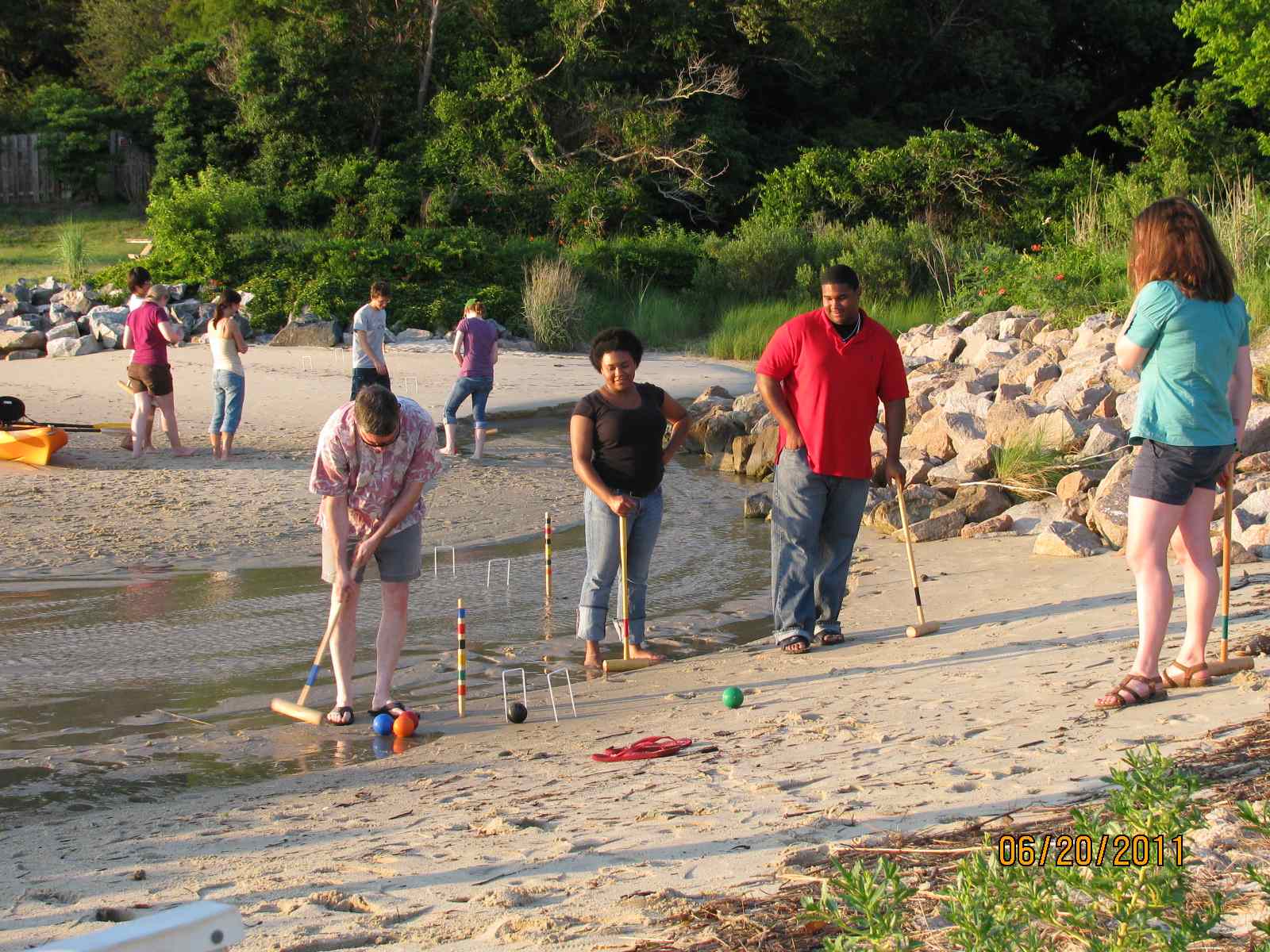
Paul D. Heideman

   Photo of P. Heideman         

         Professor              (with Research Students
& Department Chair          at Lab Croquet Party)


Year of arrival 1994. B.A., Biology, Central College, Iowa, 1979; M.S., Zoology, University of Michigan, Ann Arbor, 1982; Ph.D., Ecology and Evolutionary Biology, University of Michigan, Ann Arbor, 1987. Evolutionary Physiology. Seasonality and the evolution of neuroendocrine pathways that regulate seasonality in mammals, with an emphasis on rodents and bats. 


Mouse photo Rat photo

The Photos

(Left) A white-footed mouse, Peromyscus leucopus, our wild mouse model for studying genetic variation in brain structure and function (photo by Bryon Clark).
(Right) A lab rat from the inbred F344 strain, with a genetic background for seasonal responses to short photoperiod; one of a number of strains that differ genetically for this trait.


CURRENT RESEARCH:

What are our questions?
   Do human brains function optimally, or are our brains riddled with poorly functioning parts and connections?  No one knows the answer.  This specific question is at the heart of a major question in biology.  To what extent does natural selection optimize complex systems such as brains? 

    The big questions in my research arise from this question on optimality of complex systems.  First, how much variability is there in complex brain pathways, and, second, how do complex brain pathways evolve?  The complex brain pathway we study is the neuroendocrine pathway that uses seasonal changes in photoperiod and other cues to regulate fertility.  We study the nature and amount of variability within species, and try to understand the importance of that variability.  Why does this matter?  This is fundamental basic science research into the aspects of brain function that make individuals physiologically unique.  Understanding this variation is important in  ecology, in evolutionary biology, and in medicine.  (How and why is this important?  Click here.)

What are our study systems, or 'models'?
    My laboratory uses two different study animals (or 'models') in order to get at questions on variability in two different ways. To understand why we need two different models, consider this problem: in natural populations of humans or other mammals, every individual is different both in their genes and in their environment during life.  Thus, when we measure physiological variation in natural populations, it is very hard to determine how much of the difference is due to genes, to environment, and to measurement error.  (This problem is the reason we know so little about the sources of natural physiological variation, despite it's importance.)  Laboratory rats and mice have been inbred to the point that many laboratory strains, such as the Sprague Dawley strain of rat, have relatively low levels of genetic variation when compared to wild populations of mammals.  Biomedical researchers also have created 'inbred' strains in which all individuals are (very nearly) genetically identical by brother-sister mating for at least 25 successive generations.  This makes it possible to study genetically identical individuals within a strain, but these strains no longer contain normal variation!  Even if we compare different inbred strains, we know that none of the strains is quite natural in genetic terms.  For one thing, these inbred strains are homozygous at all loci (which is not normal in itself), and therefore typical inbred rats are homozygous for one or more deleterious recessives that would very rarely be homozygous in a wild population.  In addition, no strain carries alleles that are lethal as homozygotes but have slight effects, potentially even beneficial effects, as heterozygotes.  As a result, we've chosen to study a wild rodent species as a model that contains natural variation, and also a laboratory rat model to let us isolate known genetic differences.  (Click here for more on how we use these two models.)

     Our goal is to use these two species as model systems for natural variability in complex brain pathways.  We would like to be able to predict the kinds of complex brain variation in humans and other mammals, to be able to predict how natural populations of mammals will react to particular kinds of selection pressures (such as climate change), and even to be able to use this information to solve questions in clinical human and veterinary medicine.

What do we do, and what kind of results do we get?
     Our research has included ecological field work, artificial selection, quantitative and classical genetic analyses, photoperiod manipulations to test daily and seasonal rhythms, hormone measurements or hormone manipulation, brain manipulation by such things as neurotransmitter agonists or antagonists to stimulate or inhibit particular neural pathways, and the use of immunocytochemical techniques and autoradiography with computer image analysis systems to identify particular neurons in the brain.  I have three current research areas.  The first project examines variation in the neural pathways that regulate seasonal reproduction in field mice, Peromyscus leucopus (the "white-footed mouse").  We have tested the heritability of seasonal responses (and continue to study their genetics), and have been examining variation in the neuroendocrine components of this brain pathway. We have found variation in daily rhythms (the biological clock), variation in the abundance of melatonin receptors, in the number and location of immunoreactive GnRH neurons, in food intake, and in the way some individuals respond to food (but not leptin, the 'fat' hormone discovered recently).  The second project is a similar series of studies on several strains of laboratory rats, most of which are seasonal, and one is not.  Some of our results here have implications for studies on aging as well as on reproduction.  Finally, a third research area involves methods of assessing and predicting patterns of seasonal timing in natural populations.  Much of this work has been done on bats using existing data sets, but I've been hoping to get students interested in extending this work to rodents.

What do students do?
    Almost all of my research is carried out in collaboration with undergraduates and masters students.  Many, perhaps most, of these are true collaborations in which students develop ideas, do experiments, and write manuscripts.  In all cases, students work on at least one of these elements, though not everyone actually contributes something we can report as new findings.  At any given time there are 6-12 undergraduates and 1-2 master's students in the lab, some just beginning and others finishing up their experiments, working in my laboratory.  Usually we have a research technician who assists with some student projects and also carries out her/his own projects with me.  We also have one postdoctoral fellow  (a recent Ph.D.) who helps me run the laboratory and also teaches in one semester.   (Click here for a list of students and where they are now--updates or corrections will be appreciated!)

Finally, what can we say about our big questions to date?  
    First, there are high levels of selectable variation in the photoperiod pathway in this single population of mice.  There is variation in so many traits that I infer the variation exists in multiple genes, and probably many genes.  There are hints that variation in one trait may not always match variation in another.  For example, at least occasionally it appears that mice with no sperm in the winter may, nevertheless, attempt to mate, suggesting that they shut down spermatogenesis without shutting down the behaviorally expensive and risky behaviors associated with mating.  In addition, it appears that maintaining the ability to breed in the winter may require higher food intake (a 'cost of reproduction'), but mice with that ability eat more even in summer photoperiods!  That high food intake in summer suggests that the potential for winter mating also carries with it a higher cost of reproduction in the summer.  We have also found a large amount of genetic variation in the number of GnRH neurons we can detect with labeling, and significant heritability for number of GnRH neurons.  The story isn't complete yet.  However, putting this all together suggests that this pathway is not 'optimized'.  Rather, the population carries variation at multiple alleles.  Different combinations of those alleles are probably successful at some times and in some microenvironements, but not others.  However, because the environment is highly variable from year to year, and from place to place, selection never consistently favors any single combination of alleles.  The result appears to be a highly variable population, some of which have combinations of alleles that may be badly matched to where they happen to be born, and others have combinations of alleles that just happen to be well matched to where they happen to be born.  Probably few or none of these variable alleles are strictly deleterious--they're just different, and good or bad for an individual depending upon individual context and environment.

How might this apply to humans?  
    If human populations are similar, then we might expect high variability in the details of how our brains regulate such things as reproduction, feeding, stress, behavior, and biological rhythms.  Further, we might
expect specific combinations of alleles for these neurophysiological control mechanisms to be effective in some situations, but not others.  Humans may have combinations of alleles that may be badly or well matched to where and how we live.  Probably few or none of these variable alleles are strictly deleterious--they're just different, and good or bad for an individual depending upon individual context and environment.  


Publications

56  research and review papers, 1981-2006

     Publications: 1990 & after

     Publications: 1981-1989


Invited and Contributed Papers

  • A total of 29 papers presented since 1990.  
  • Current Research Grants:

    • (National Institutes of Health grant proposal currently in review)


    [Biology Home Page]

    Last updated  2/1/08
    College of William and Mary, Department of Biology
    pdheid@wm.edu